Breakout and Retest on Gold (XAUUSD): Step by Step
How to trade a breakout and retest on gold (XAUUSD), step by step, from beginner to pro: what a breakout and a retest are (price escapes a box, comes back to knock on the lid, and holds); why the old ceiling becomes a floor (trapped sellers and late buyers); the six steps (an objective box, context, a candle close beyond the edge, the retest, the reaction, the plan); how to tell a real breakout from a fakeout; three ways in (break close, limit at the edge, retest reaction); three real trades on the chart with entry, stop and target (an Asian range, a four-hour box, and a floor that broke); where the stop and target go, the big mistakes, and a six-point checklist.
Chapters
- 0:00One real trade: box, break, retest, target
- 0:38What a breakout and retest is
- 1:17Why the old ceiling becomes a floor
- 1:54The six steps
- 2:47Real breakout or fakeout?
- 3:31Three ways in
- 4:02Trade one: the Asian range
- 5:25Trade two: the big box, step by step
- 7:12Trade three: the floor breaks
- 9:00Stops, targets and the big mistakes
- 9:51Your checklist
- 10:20Recap
Key points
A breakout and retest: price closes beyond a clear box edge, comes back to test that edge, and holds on the other side.
The old ceiling becomes a floor because trapped sellers and late buyers defend the level on the retest.
Six steps: an objective box, context, a candle close beyond the edge, the retest, the reaction, and a written plan.
Three real gold trades from the written rules (Aug and Oct 2026) reached their targets: 2.8R, 4.6R and 5.2R before costs.
Stop back inside the box, target the box height; breakouts on gold often fail, so wait for the close and the retest.
Chart data: COMEX gold futures 1-hour bars from Yahoo Finance (GC=F), times in UTC, 4-hour bars built from them. The three example trades were chosen because they reached the target; no win rate is claimed, and R values are before costs. Education only, not a signal.
Read more: Gold Breakout and Retest Strategy for XAUUSD · Asian Range Breakout on Gold: Trading the London Open Breakout and the Judas Fakeout on XAUUSD · Gold Support and Resistance Strategy: Trading XAUUSD Levels · XAUUSD Market Structure: Trends, BOS and CHoCH Explained · Liquidity Sweeps on XAUUSD: How Gold Stop Runs Work · Breakout · Retest · Fakeout · XAUUSD position size calculator
Transcript
For a week in August, gold was stuck in a box, between 4,365.5 and 4,509.1. It hit the top four times, and was turned away. Then on 19 August, a four-hour candle closed far above the box. The next day, price came back down to the old top. It held. And it ran 123 points, straight to the target. That's a breakout and retest. In this lesson: why the old edge flips, the six steps, how to spot a fake, three ways in, and three real trades, step by step.
Chapter one. What a breakout and retest is. Picture a box: gold bouncing between a floor and a ceiling. A breakout is price escaping the box: a candle closes outside it. Not just a wick poking out. A real close. A retest is price coming back to knock on the lid, from the outside. If the old ceiling now holds price up, like a floor, the escape is believable. If price falls back into the box, the escape failed. So the idea has three parts. One: the close outside. Two: the return to the edge. Three: the hold. You trade only after all three.
Chapter two. Why the old ceiling becomes a floor. Traders who sold the top of the box are now losing. Many of them buy back near their entry, right at the old top. Traders who missed the breakout want a cheaper price, so they place buy orders at the edge. Both groups put buying exactly where selling used to be. It works the same way down. After a break below the floor, the old floor becomes a ceiling. And one pro detail: the first retest matters most. By the third or fourth visit, far fewer traders still care.
Chapter three. The six steps. Step one: draw the box objectively. Use clear highs and lows, with at least two touches on each side, or a fixed time window, like the Asian session. Step two: context. Does the bigger chart agree with the direction? Is big news due? Step three: confirm the breakout with a candle close beyond the edge. A strong body helps. Step four: wait for the retest. Let price come back to the edge. On gold, retests often poke a few dollars back inside. That's normal. In this lesson, a retest means an hour that comes within 5 dollars of the edge, or a little through it. Step five: the reaction. That same hour must close back outside the box. And step six: write the plan before you click. The entry, the stop and the target.
Chapter four. Real breakout, or fakeout? Gold is famous for false breakouts. Price pokes out of the box, grabs the stop orders sitting there, and snaps back inside. Traders call that a liquidity sweep. The breakout candle tells you less than the next two or three. Signs of a real breakout: the closes stay outside the box, the break candle closes near its extreme, and the dip back to the edge is shallow, and bought fast. Signs of a fakeout: a weak close just past the edge, with a long wick. The next candle closes back inside. And the move came in a quiet hour. A close back inside means the idea is wrong. No trade.
Chapter five. Three ways in. Way A: enter on the breakout close. You never miss a move. But the stop is the widest, and you catch the most fakeouts. Way B: a limit order, resting at the edge. The best price. But no fill if price never comes back. Way C: wait for the retest hour to close back outside. The most proof, at a slightly worse price. This lesson uses way C. Pick one way, and don't switch from trade to trade.
Chapter six. Trade one: the Asian range, a small box. 18 August. From 8 p.m. to midnight New York, that's midnight to 4 a.m. UTC, gold built a small box, from 4,378.0 to 4,415.8. A height of 37.8 dollars. At 5 a.m. New York, in the London morning, an hour closed above the box, at 4,416.4. That's only 0.6 above the top. A weak close. Then the retest. The next hour dipped to 4,413.8, 2.0 back inside, and closed above the edge, at 4,422.2. An overshoot, then a close back above. The plan. Entry at 4,422.2. The stop goes under the retest low, minus 3 dollars: 4,410.8. A risk of 11.4. The target is the box height, added to the top: 4,453.6. That's 2.8R. At 8 a.m. New York, gold jumped straight through the target. And look where that hour stopped: at 4,499.8, right under a much bigger ceiling.
Chapter seven. Trade two: the big box, step by step. On the four-hour chart, after climbing 356 dollars from the 4 August close, gold stalled. From 11 August to 19 August, it sat in a box, from 4,365.5 to 4,509.1. Four tests of the top, two of the bottom. A height of 143.6 dollars. The bigger trend was up. On 19 August, the four-hour candle from 8 a.m. New York closed at 4,552.2. That's 43.1 above the top, with a big body. A strong breakout close. Now comes the hard part: waiting. Price ran to 4,583.8, a full 74.7 above the edge. Buying up there means a wide stop. So you wait. 20 August, 8 a.m. New York. On the one-hour chart, price dips to 4,506.0, 3.1 back inside the box. And the hour closes back above, at 4,529.7. That's the retest and the reaction, in one candle. Entry at 4,529.7. The stop goes under the retest low, minus 3 dollars: 4,503.0. A risk of 26.7. The target is the top plus the height: 4,652.7. After the entry, the lowest price was 4,524.1. 21 hours later, the target was hit. 123 points. That's 4.6R.
Chapter eight. Trade three: the floor breaks. By October, gold had fallen 436 dollars from its September high. From 16 October to 21 October, it built a box, from 4,122.3 to 4,220.4. Three tests of the floor. A height of 98.1. At 11 p.m. New York, on 21 October, an hour closed at 4,107.3. That's 15.0 below the floor. And the four-hour candle closed there too. Price dropped to 4,082.4. Then, at 2 a.m. New York, the London open, it climbed back to 4,118.7, just 3.6 under the old floor. And the hour closed back below, at 4,108.9. The old floor was now a ceiling. So this time, it's a sell. Entry at 4,108.9. The stop goes above the old floor, plus 3 dollars: 4,125.3. A risk of 16.4. The target is the floor minus the height: 4,024.2. Price never got back above 4,117.3. That same evening, New York time, the target was hit. 84.7 points. That's 5.2R. Sizing, with example numbers. A 5,000 dollar account, risking 1 percent: that's 50 dollars. The 16.4 dollar stop gives 0.03 lots. So 49.2 dollars at risk, and 254.1 dollars at the target, before costs.
Chapter nine. Stops, targets, and the big mistakes. The stop goes back inside the box, beyond the retest. Not exactly on the edge. Retests on gold overshoot, and a stop right on the line gets taken by normal noise. Use the box height as a check. If your stop would be bigger than the box itself, the trade makes no sense. Targets. The measured move, the box height, is the simple one. You can also use the next big level, the previous day's high or low, or trail the stop behind new swings. Decide before the entry, and log it. And the big mistakes. Chasing a breakout that never came back. Entering on a wick, not a close. Trading a break just before big news. And adding to a trade that has fallen back inside the box.
Chapter ten. Your breakout and retest checklist. One: a clear box, with two touches or more on each side. Two: the bigger chart agrees, and no big news is due. Three: a candle close outside the box. Four: a retest, within a few dollars of the edge. Five: the retest hour closes back outside. Six: the stop inside the box, the target set, and the size from the stop. All six, or no trade.
Let's recap. A breakout is a close outside the box. A retest is the return to the edge. And the hold is your proof. Trapped sellers and late buyers turn the old ceiling into a floor. Wait for the close, wait for the retest, and put the stop back inside the box. Three real trades: 2.8R on the small box, 4.6R on the big box, and 5.2R when the floor broke. The same steps, every time. The full written guide is on our website, link in the description. Subscribe for the next lesson, and join our gold community, to learn with other gold traders.
Other short videos
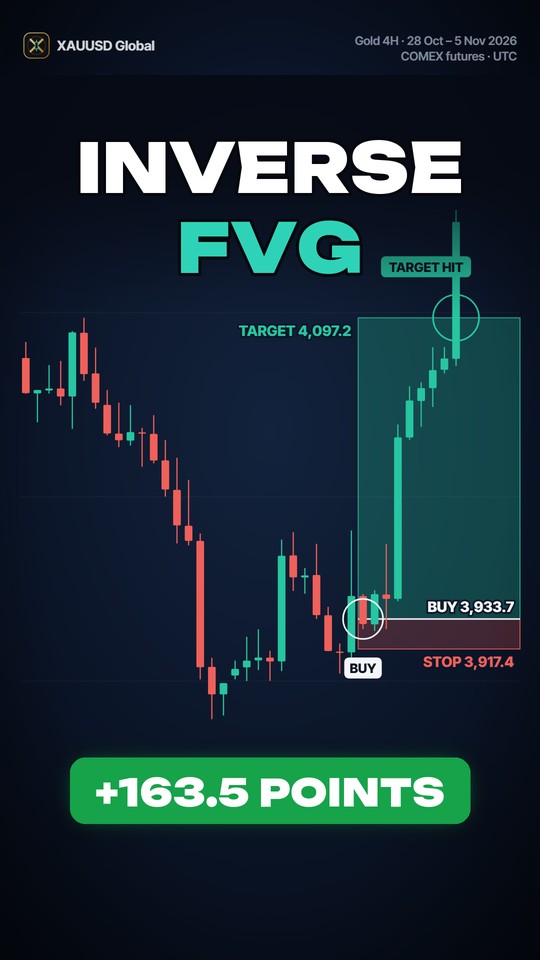
Inverse Fair Value Gap: When the Gap Fails and Flips
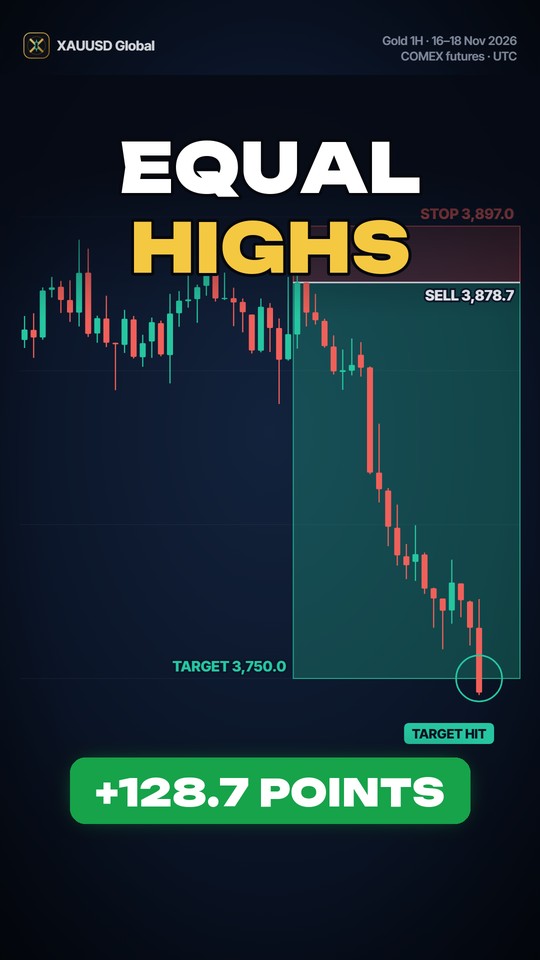
Equal Highs on Gold: Where the Stops Get Grabbed

Trendlines and Channels on Gold (XAUUSD): Step by Step