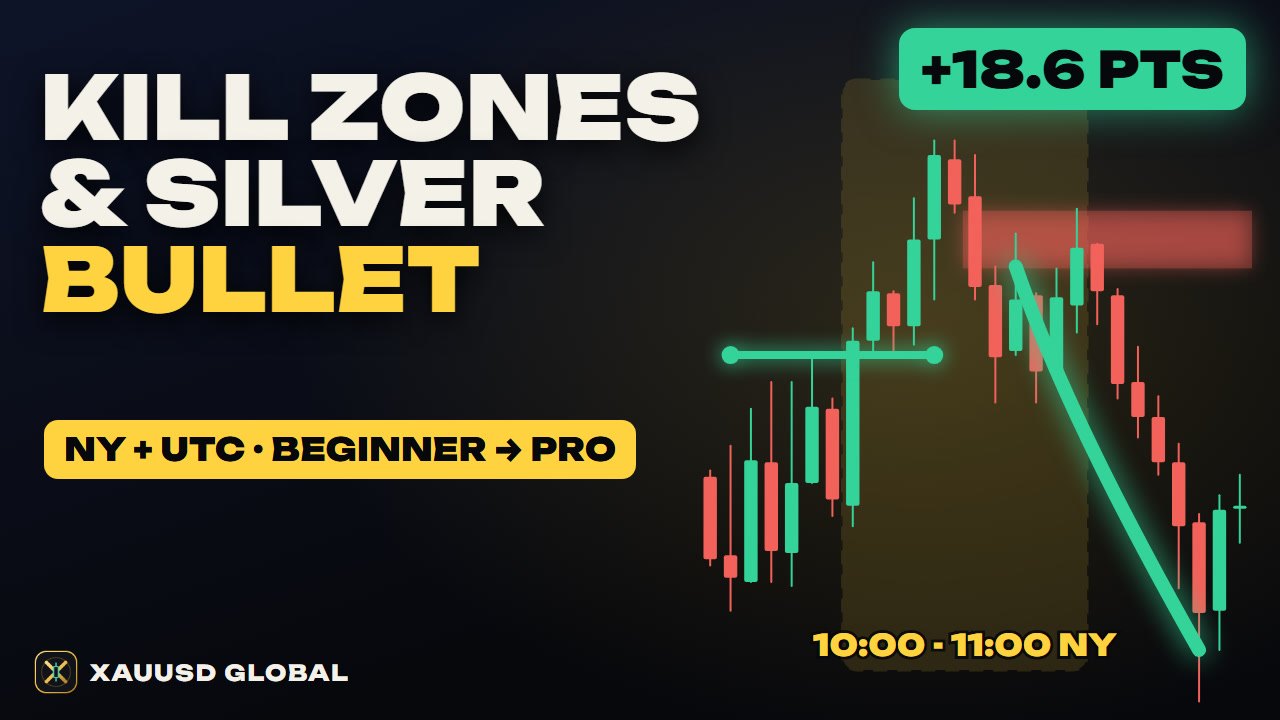
Gold Scalping Strategy (XAUUSD): Beginner to Pro on the 5-Minute Chart
Gold (XAUUSD) scalping from zero to the pro level, taught on real 5-minute and 1-minute gold charts. You will learn what scalping is and who it suits, the real costs (spread, commission and slippage, with simple example numbers that show why costs eat tiny targets), the best hours to scalp (the London open, the New York open and the overlap) and when not to (the news minutes and the quiet hours around the daily close), a simple 5-minute model with a one hour bias (the VWAP pullback), position size from the stop, a daily loss limit and a three-losses-in-a-row rule, where the stop goes (beyond the low, at least one ATR away), targets in R, and how pros grade a scalp and test it. One real trade is walked from start to finish, and a real failure is shown: three pullback buys stopped in one hour after a US jobs report.
Chapters
- 0:00A real gold scalp, start to finish
- 0:44What scalping is, and who it suits
- 1:31The real costs: spread, commission, slippage
- 2:24The best hours, and when not to scalp
- 3:24A simple 5-minute model: the VWAP pullback
- 4:21Position size and a daily loss limit
- 5:21Where the stop goes, and targets in R
- 6:02One full trade, start to finish
- 6:58When it fails: three stops after the jobs report
- 8:08Pro level: grading, routine and testing
- 9:046 scalping mistakes
- 9:31Should I take this scalp? (flowchart)
- 10:06Recap
Key points
Scalping means many short trades on the 1- or 5-minute chart; it suits people who can watch the screen at fixed hours and follow rules without hesitation.
Costs (spread, commission, slippage) are paid on every trade, win or lose, so tiny targets need far more wins to break even.
Scalp the busy hours (London open, New York open, the overlap) and stay flat a few minutes before and after big US data.
Size the position from the stop, set a daily loss limit, and stop for the day after three losses in a row.
Test any scalping model on a demo with your own costs first: on our 5-minute data the simple VWAP pullback was stopped more often than it reached its target.
Chart data: COMEX gold futures OHLC from Yahoo Finance (GC=F), times in UTC. Education only, not a signal.
Read more: Gold Scalping Strategy: How to Scalp XAUUSD on M1 and M5 Without Letting Costs Eat You Alive · Gold Scalping Course · Scalping · Slippage · Daily loss limit · Atr
Transcript
Gold, five minute chart, 16 September 2026, the New York morning. The one hour trend was up, and all morning, price stayed above VWAP. Then it pulled back, dipped to VWAP, and closed back above it. That's the buy. The stop goes under the low, and the target is two times the risk. About half an hour later, the target was hit. 15.4 points, for 7.7 points of risk. The stop was never touched. This is gold scalping. You'll learn the real costs, the best hours, a simple five minute model, position size, stops and targets, and the daily limits that keep you in the game. Plus a day where the same model lost three times in a row.
Chapter one. What scalping is, and who it suits. Scalping means small, quick trades. You hold for minutes, not days, and aim for a few points at a time. Gold is popular for it, because it moves a lot, and trades almost around the clock. But speed works both ways. A stop can be hit just as fast as a target. Scalping suits you if you can sit at the screen for a fixed hour or two, with no distractions, and follow your rules without arguing. It does not suit you if you trade between meetings, or if one loss makes you angry. One honest note. Scalping is the hardest way to trade gold. When we tested simple one and five minute rules on real gold data, they lost money after costs. So learn it on a demo first.
Chapter two. The real costs. Every scalp pays three costs. The spread: the gap between the buy price and the sell price. A commission, on some accounts. And slippage: when your order fills at a worse price than you wanted. Here's an example with typical numbers. Together, they come to about 30 cents an ounce, on every trade, win or lose. Now take a tiny scalp: a target of 1 point, and a stop of 1 point. After costs, a win makes only 0.7. A loss costs 1.3. You need almost two wins to pay for one loss. With a bigger target, the same cost hurts much less. On the trade from the start, the target was 15.4 points, so 30 cents was small change. So check the cost against your target before every trade. Small targets need tiny costs.
Chapter three. The best hours, and when not to scalp. Gold doesn't move the same all day. We measured every five minute candle, from September to November 2026. The New York open moved the most, by far. The London open is the other classic window, with busy markets and tight spreads. Often the best part is the overlap, when both are open. The hours around the daily close were the quietest. Small candles, and that's when spreads are often widest. Skip them. Asian hours are often called thin. In 2026, not always. So measure your own hours. Now the news minutes. 10 November 2026, US inflation data, at 8:30 New York time. In one single minute, gold traded 44.1 points, from top to bottom. A tight stop above was taken. A tight stop below was taken too. So be flat a few minutes before big news, and wait a while after it.
Chapter four. A simple five minute model: the VWAP pullback. VWAP is the volume weighted average price of the day. While price holds above it, buyers are in control. The VWAP lesson covers it in full. Step one. The bias, from the one hour chart. Higher highs and higher lows? Only buys. Lower highs and lower lows? Only sells. Mixed? No trade. Step two. The window: the London open or the New York open, with no big news coming. Step three. Location. For a buy, price must be above VWAP. Step four. The trigger. A five minute candle dips to VWAP, and closes back above it, as an up candle. Step five. Buy at that close. Stop under the candle's low. Target: two times the risk. Sells are the mirror image.
Chapter five. Position size, and a daily loss limit. First, decide how many dollars you can lose on one trade. Say your account is 5,000 dollars, and you risk 25 dollars a trade. On gold, 1 lot is usually 100 ounces. So 0.01 lots is 1 ounce, and every 1 point move is worth 1 dollar. Our stop was 7.7 points away. 25 divided by 7.7 is about 3.2 ounces. Round down: 0.03 lots. The real risk is 23.1 dollars, plus costs. The stop decides the size. Never the other way round. A tiny stop, just to trade a bigger size, is how many scalpers blow up. Now the daily limits. Stop after three losses in a row. Stop when the day is down 75 dollars: three full losses. And cap your trades, for example 6 a session. Write the limits down before you start.
Chapter six. Where the stop goes, and targets in R. The stop goes where the idea is wrong. For our buy, that's under the trigger candle's low, with a 1 point buffer. Then check the noise. ATR is the average size of a candle. If the stop is closer than one five minute ATR, widen it to one ATR, and trade a smaller size. R is your risk. One R is the distance from the entry to the stop. A target of 2R is twice that distance. With 2R targets, one win covers two losses, before costs. That's why scalpers count in R, not in points or dollars.
Chapter seven. One full trade, start to finish. Step one. The one hour chart, into the morning of 16 September. A higher low, then a higher high. Bias: up. Buys only. Step two. The New York morning, with London still open: the overlap. Step three. Since before the London open, every five minute close was above VWAP. Step four. Gold fell from its morning high, and one candle dipped below VWAP, then closed back above it, as an up candle. That's the trigger. Step five. Buy at the close. The stop goes 1 point under the low. That was already wider than one ATR, so no change. Target: 2R. Price climbed back, and about half an hour later, the target was hit. The stop was never touched. Within the hour, gold traded 29 points above the entry.
Chapter eight. When it fails. 2 October 2026. A US jobs report at 8:30 New York time. The one hour bias read up. In one five minute candle, gold jumped 42.1 points. Then it gave the whole jump back, all the way down to VWAP. It looked like a perfect pullback. Buy number one. Stopped. Price closed back above VWAP. Buy number two. Stopped. Buy number three. Stopped. Three losses in a row, in one hour. The rule says: three in a row, and you're done for the day. That rule saved you. An hour and a half later, gold traded 67.7 points below the last entry. What went wrong? The bias came from swings before the news. The jump, and the full give-back, changed the picture. And VWAP had gone flat. Price crossed it again and again. A flat VWAP means chop, not a trend. So after big news, wait for new swings on the one hour chart. And when price keeps crossing a flat VWAP, stop looking for pullbacks.
Chapter nine. The pro level. Pros grade every scalp. Is the bias clear? Is it the right window? Is VWAP sloping your way? Is the stop wider than the noise? Is the cost small next to the target? All yes: an A trade, normal size. One weak point: a B, half size. More than one: skip it. They keep a routine. Before the session: mark yesterday's high and low, check the news calendar, and note the spread. During it, a time stop: if a scalp hasn't moved in 6 candles, close it. And they test. On our five minute data, from 8 September to 13 November 2026, this exact model was stopped more often than it hit its target, and in R, it lost. That's normal for simple rules. So log every trade, review them in batches of 20, and only go live if your own results say so.
Chapter ten. Six scalping mistakes. One. Ignoring costs on tiny targets. Two. A stop inside the normal noise. Three. Scalping into the news. Four. Trading the quiet hours, around the daily close. Five. Revenge trading after a loss, or doubling the size. And six. No daily limit.
Chapter eleven. Should you take this scalp? Any no, and you skip it. Is the one hour bias clear? If not, skip. Is it the London or New York window, with no big news coming? If not, wait. Is price on the right side of VWAP, and did a candle just reject it? If not, wait. Is the stop wider than one ATR, with costs small next to the target? If not, skip. Are you inside your daily limits? Then write down entry, stop and target, and only then place the order.
Let's recap. Scalping means small, fast trades. Costs are paid on every trade, so small targets need tiny costs. Trade the London and New York opens. Skip the daily close, and be flat around big news. The model: a one hour bias, the right window, price on the right side of VWAP, a rejection candle, a stop beyond the low, and a 2R target. Size from the stop, and stop after three losses in a row. Next lesson: market structure. The full written guide is on xauusdglobal.com. Subscribe so you don't miss it, and come trade with us in the XAUUSD Global community. It's free during early access.
Other short videos
Elliott Wave on Gold: 3 Rules, Fibonacci Targets, Real XAUUSD Trades
Volume Profile on Gold: POC, Value Area, HVN/LVN, Naked POC
Power of Three (AMD) on Gold: The Fake Move and the Real Move